
Less hardware, lower cost
Dozens of physical servers consolidate onto a handful of hosts: less to buy, less power and cooling, less rack space. A new server goes from a weeks-long order to a few minutes of provisioning.
Official Proxmox partner
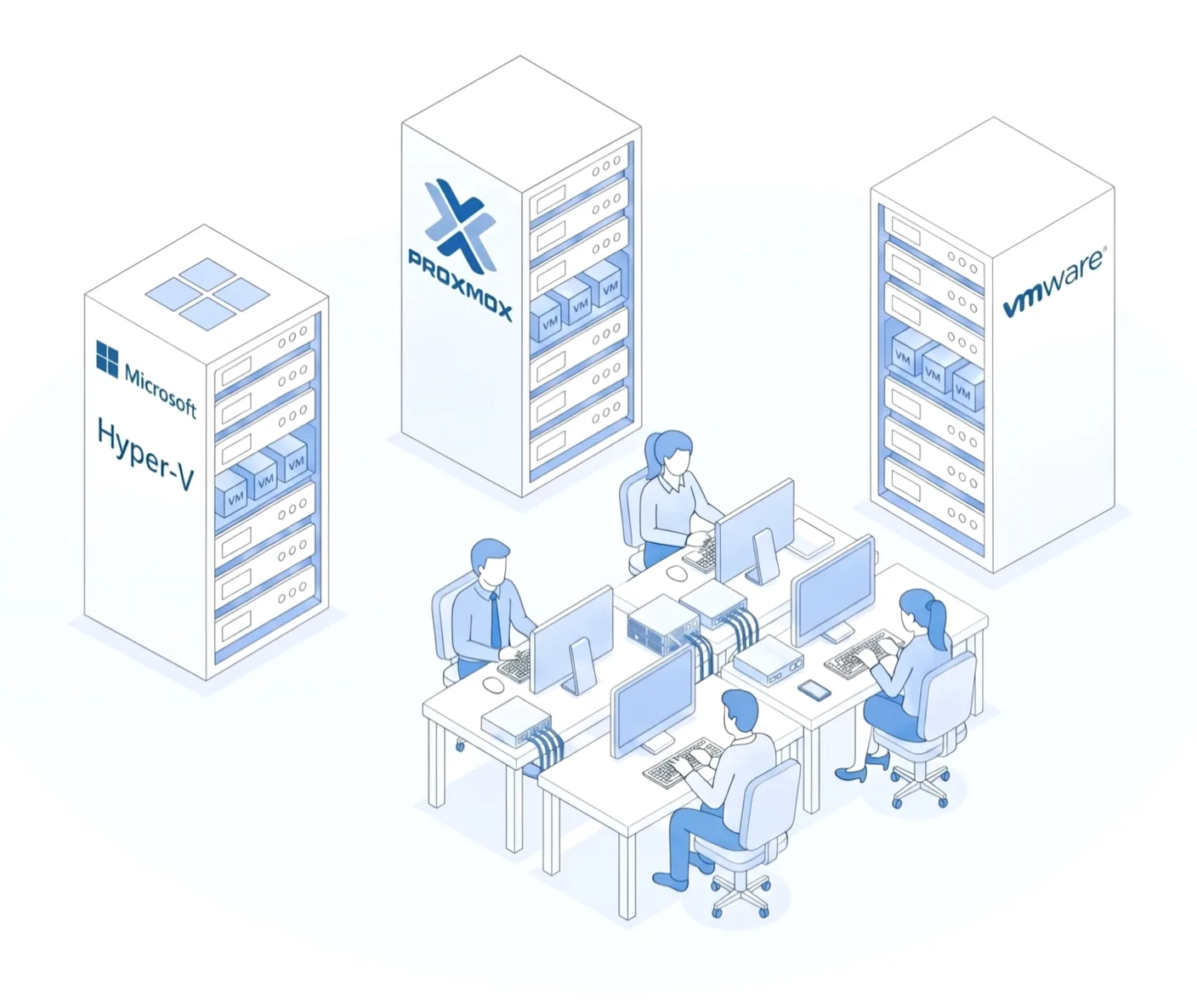
ILS Networks specialises in the three leading virtualisation environments — VMware, Proxmox and Hyper-V — and works with organizations from assessment and design, through build and migration, to day-to-day operation. One party accountable for the whole layer.
Overview
Assessing the estate, designing the cluster, building it, migrating the machines, the backup system underneath it and the day-to-day operation once everything runs — all from one party. You are not brokering between a hardware supplier, a consultant and a maintenance contractor, and you are not left with an environment nobody knows in depth once the project closes.
The work follows a fixed method: a pilot before any move, maintenance windows the organization defines, a way back at every stage, acceptance testing and full documentation of what is handed over. That is why projects here finish on the date that was set rather than drifting.
The three platforms we work with most are Proxmox, VMware and Hyper-V — not a closed list. If something else runs in your estate, we will design, build and maintain that too, including the case where the recommendation is to stay on what already runs and upgrade it.
We work with organizations over years rather than over a single project — Ariston Group for around six years running the entire estate, Combe for more than fifteen, CooperVision and Galmarine for about five each.
Why virtualise
The practical differences between a physical estate and a virtualised one — in cost, in availability and in security — as they are felt in day-to-day operation.
Dozens of physical servers consolidate onto a handful of hosts: less to buy, less power and cooling, less rack space. A new server goes from a weeks-long order to a few minutes of provisioning.
A single host failing does not take the service down — the machines restart on another host. Planned maintenance happens without taking users offline.
A whole machine comes back from backup as it was, instead of building a server from scratch and reinstalling everything that ran on it. That is the difference between an incident and a lost working day.
Each system runs in its own environment, so a fault or a compromise in one does not automatically spread to the rest. Traffic between groups of machines can be separated at the network level as well.
A snapshot before an update or a configuration change, and a way back within minutes if something misbehaves. A change can be tested on a copy of production before production itself is touched.
Adding CPU, memory or storage to an existing system happens without buying a new server and without a long maintenance window.
The environments
We design, build and maintain all three, and choose between them from the estate rather than from a preference. Moving from VMware to Proxmox is a project in its own right, so it has a page of its own.
How to choose
Tick what is true for you. The cards above will mark where your answers point — not to replace a survey, but to show which way it leans.
FAQ
Virtualization separates the physical server from the systems running on it: instead of a dedicated server per system, several virtual machines share one host under a management layer called a hypervisor. The result is better hardware utilization, faster recovery after a failure, and the ability to move a workload between hosts without taking it down.
From the existing environment and its licensing, not from preference. Hyper-V suits an organization already standardized on Microsoft; VMware suits a mature estate with a team that knows it; Proxmox suits an estate where licensing cost has become the deciding factor or where open source is wanted. This topic page includes a tool for weighing the four main considerations.
No. Virtualization is the technology — several virtual machines sharing one host — while "cloud" is the question of where that hardware sits and who owns it. A cloud virtual server, a VPS, is the same virtual machine running on a provider's infrastructure instead of on a server in the office. ILS Networks builds and runs both, and colocation as well — hardware the organization owns, housed in a data centre.
Hybrid cloud means running some systems on the organization's own site and some outside it, as two halves of one managed estate. It fits where some systems have to stay close — for performance, for attached equipment or for a regulatory requirement — alongside systems there is no reason to keep on your own hardware. The mix between on-premises, colocation and cloud follows from establishing what actually runs on each server, not from a rule of thumb.
Also written: Proxmox VE · פרוקסמוקס · פרוקסמוקס VE · Proxmox · Proxmox Virtual Environment
Next step
A short technical call: what runs today, where the licensing stands, and what is right for your estate — stay, upgrade or move. No commitment, and a straight answer.
Thanks for contacting ILS Networks. We will come back to you shortly. If it is urgent, you can also call us directly.
+972-54-454-6020