
One component failing does not stop the business
A core with real redundancy and dual paths: losing a switch, a power supply or a single link does not take the organization down. Maintenance happens without shutting the business off.
Four tiers
A network is not one product but four tiers, built in a particular order and failing in a particular order. ILS Networks designs and builds all of them — core, access, wireless and site connectivity — with equipment chosen for the environment rather than off a shelf.
Overview
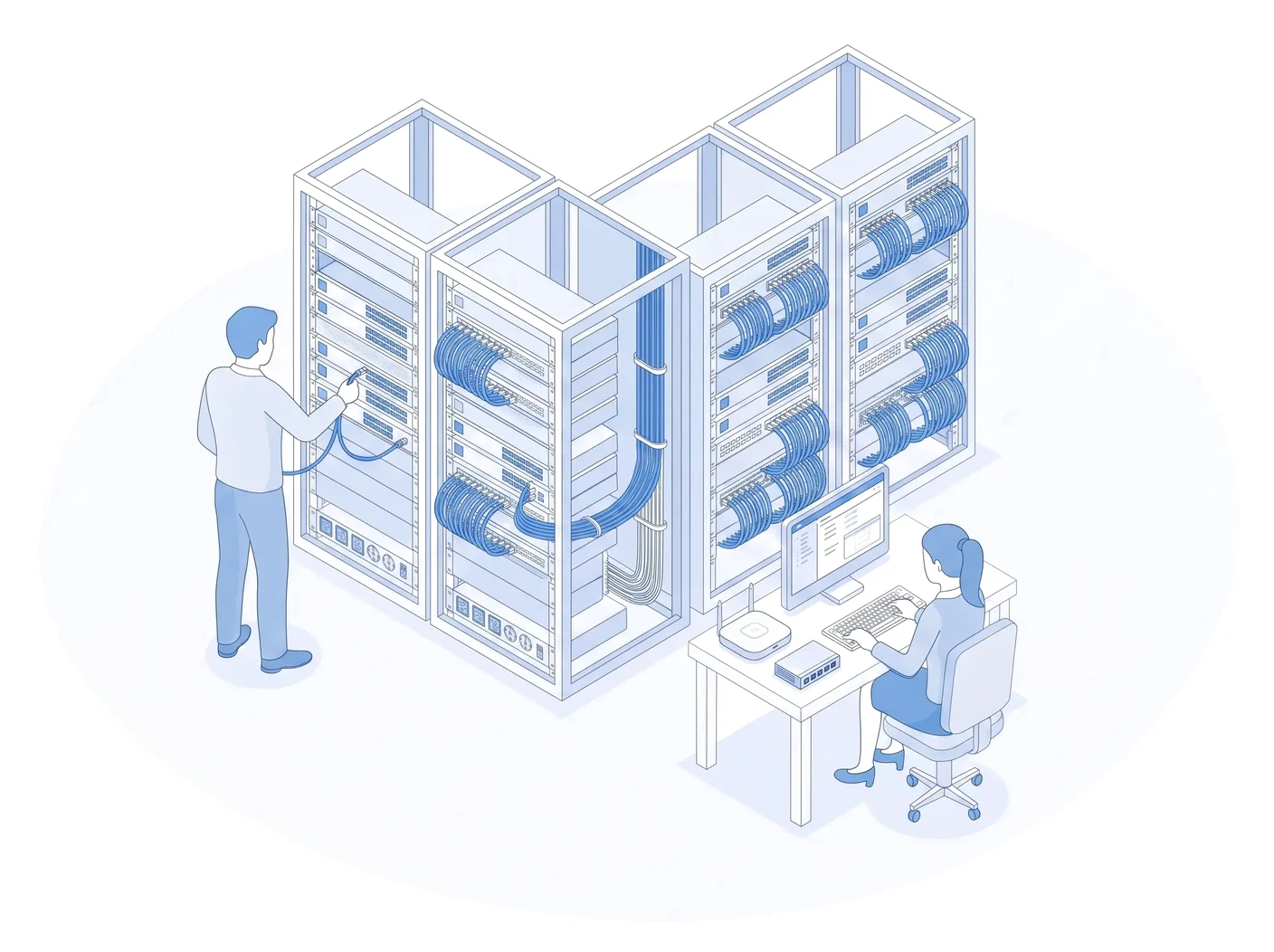
ILS Networks is responsible for the whole network layer: core and switching, segmentation, enterprise wireless, and connectivity between sites and branches. We specify the structure, supply and deploy the equipment, and operate it afterwards — so no organization is left with a network built by one party and maintained by another.
The work follows a fixed method: mapping before any change, maintenance windows the organization defines, a way back at every stage, acceptance testing and full documentation of what is handed over. That is how projects finish on the date that was set rather than drifting.
The main vendors we work with in this layer are Arista for core and switching, Aruba for access switching and wireless, and Alcatel-Lucent Enterprise for switching and enterprise communications. These are the platforms we work with most, not a closed list. If something else runs in your estate, we will design, build and maintain that too.
We work with organizations over years rather than over a single project — Ariston Group for around six years running the entire estate, Combe for more than fifteen, CooperVision and Galmarine for about five each.
Why a designed network
Enterprise network infrastructure is not just switches and cabling. These are the practical differences between a network that grew on its own and one that was designed — in availability, in performance and in security.
A core with real redundancy and dual paths: losing a switch, a power supply or a single link does not take the organization down. Maintenance happens without shutting the business off.
Bandwidth and priority planned so that a nightly backup, a large update or a conference call does not choke everyone else.
Segmentation and VLANs instead of one flat network: guests, cameras, production and office sit apart. Someone who gets in at one point does not automatically reach the rest.
Network access control, a separate guest network and central management of the wireless — so joining the network is a decision rather than a default.
Sites connected under a single policy, instead of each branch being maintained separately with settings of its own.
Monitoring and documentation of what is connected where. When something drops you know where to look, instead of hunting for a cable.
The structure
Each tier has its own job and its own failure mode. Here is what gets built at each, and on which platforms.
Tier 1
The core is where the rest of the network meets. When it goes down the site goes down, so it is built fully redundant and upgraded without taking the organization offline.
What gets built here
Platforms
Tier 2
The layer users, printers, cameras and operational equipment actually plug into. Segmentation is decided here too — who can see whom, and what is kept apart from what.
What gets built here
Platforms
Tier 3
Enterprise wireless is not access points hung on a wall: it is a coverage survey, channel planning and access policy — otherwise it fails exactly when it is being used.
What gets built here
Platforms
Tier 4
An organization with more than one site needs branches to behave like head office — same policy, same security, and redundant links so a single line failure does not isolate a branch.
What gets built here
Platforms
The platforms
No single vendor is the answer at every tier, so we work with three and choose by tier and by estate. These are the vendors we work with most, not a closed list. If other equipment runs in your estate, we will design and maintain that too.
Common questions
Yes, and that is how we work. A core upgrade runs in stages: the new topology is built alongside the existing one, traffic is moved across in agreed windows, and every stage has a way back. A full outage is rarely required, and where it is, it is planned in advance rather than discovered along the way.
We mix, by tier. Core and backbone are one world; access and wireless are another, and the same vendor is not always the right answer for both. We also weigh what the organization already owns — replacing working equipment purely to consolidate a vendor is usually spend without return.
MLAG lets a device connect to two core switches at once as though they were one. In practice: losing a single core switch does not disconnect what is attached to it. It is the standard way to get real redundancy in the core rather than redundancy on paper.
Redundant links — more than one path back to the central site, so a single line failure does not isolate a branch. Alongside that you need uniform policy: the same segmentation and the same security rules at the branch as at head office, otherwise the branch becomes the weak entry point.
Mostly in the planning. A coverage survey based on actual use, channel planning so access points do not interfere with each other, separation between guest and corporate networks, and central management. Without those you get a network that passes a test and fails when everyone uses it at once.
Yes. We begin by mapping and documenting what exists — topology, configuration, segmentation and failure points — and only then take on operations. Without that documentation every ticket starts from diagnosis, which is exactly what we are there to prevent.
Four layers: the core and backbone carrying all traffic, the access layer on each floor, enterprise wireless, and connectivity between sites and branches. Alongside them sits the physical work — comms cabinet, structured cabling and server-room layout — because a well-designed network deployed untidily fails on maintenance.
No. We encounter Cisco equipment in client environments and work with it, but we hold no formal Cisco partnership. Our network-layer partnerships are with Arista and with Alcatel-Lucent Enterprise.
Next step
A short technical call: how the network is built today, where the failure points are, and what it needs to carry what the organization is planning. No commitment.
Thanks for contacting ILS Networks. We will come back to you shortly. If it is urgent, you can also call us directly.
+972-54-454-6020